
Online Data Science & AI Bootcamps in Canada: Cost, Curriculum & Career Outcomes Compared (2026 Guide)
Updated on November 27, 20256 minutes read
Heading into 2026, demand for data talent in Canada remains strong. Job Bank wage data for NOC 21211 (Data Scientists) shows a national median of about CA$96,000 per year for recent years.
Glassdoor salary reports put the average Canadian Data Scientist salary around CA$100,000 per year, with experienced profiles and total compensation going higher in major hubs like Toronto, Vancouver, and Montréal.
Because many employers now hire fully remote or hybrid teams, an online bootcamp lets you choose the program that fits your goals instead of being limited to the nearest campus.
1. Bootcamp snapshot: cost, pace, and format
Use this table as a starting point and always confirm current tuition and discounts with admissions before applying.
| Bootcamp | Format | Duration | Tuition (CAD) | Financing highlights |
|---|---|---|---|---|
| Code Labs Academy (Data Science and AI, Canada cohorts) | Live online, full- or part-time | 12 weeks (FT) / 24 weeks (PT) | CA$7,499 | 0% interest installment options with flexible monthly payments |
| Lighthouse Labs (Data Science) | Live online / hybrid | 12 weeks FT / 30 weeks Flex | CA14,000 | Career coaching, demo days, financing partners |
| BrainStation (Data Science Bootcamp) | Live online or Toronto/Vancouver campus | 12 weeks FT, evenings or weekends PT | ~CA16,500 (varies by campus and intake) | Career services team, hiring events, “Career Success” programming |
| Le Wagon (Data Science Course) | Live online or Montréal campus | ~2 months FT / 6 months PT | Typically around CA12,500 (location dependent) | Global alumni network and international campus options |
Tip: Providers can change pricing several times a year. Treat these numbers as reference ranges and verify the latest tuition and financing options on each school’s official website.
2. Curriculum deep-dive
All four providers cover a similar core stack (Python → SQL → statistics → machine learning and AI → data storytelling). They differ in depth, AI focus, and project count.
Code Labs Academy
Around 500 hours of guided learning and live sessions across full-time or part-time formats. Dedicated modules on machine learning, deep learning, and Generative AI / LLMs. Three substantial capstone projects aligned with real business problems.
Lighthouse Labs: Project-based curriculum with pair programming and daily labs. Data science stack includes Python, SQL, statistics, and machine learning, with some cohorts offering exposure to NLP and LLM tooling.
BrainStation: Emphasises portfolio-building with five projects, including a major capstone that often uses real company-style datasets. Strong focus on practical tools such as cloud notebooks, dashboards, and collaboration workflows.
Le Wagon: Intensive curriculum covering data analytics, decision science, machine learning, deep learning, and elements of ML engineering in a compressed time frame. Global, template-based curriculum with a strong international community. Local cohorts may add examples from Canadian datasets.
When comparing syllabi, look for:
End-to-end projects from raw data to a deployed model or dashboard. Modern AI coverage, including transformers, LLMs, vector database,,s and responsible AI practices. Soft skills such as communication, stakeholder presentations, and working in cross-functional teams.
3. Career outcomes and salaries in 2026
Salary bands in Canada
Based on Job Bank and recent salary platforms, a realistic 2026-oriented view looks like this:
- Entry-level and junior roles (Data Analyst, Junior Data Scientist): roughly CA80,000 per year in most metro areas.
- Mid-level Data Scientists: commonly CA110,000 per year, with fintech, health , AI,, and SaaS firms often paying toward the upper end.
- Senior, lead or specialised ML/AI roles can reach CA$130,000 or more in total compensation, especially in major tech hubs or global companies.
Job Bank outlooks show moderate to good three-year prospects for Data Scientists across most provinces, with particularly strong signals in some regions of Western Canada.
How bootcamps influence outcomes
Bootcamps can compress years of self-study into a structured three to six-month journey, but outcomes still depend on:
The quality and quantity of projects you complete. How consistently you network and apply, especially in Toronto, Vancouver, Montrél, and Ottawa. The strength of your career support, including mock interviews, rrreferralsne-to-one coaching.
Code Labs Academy, BrainStation, Le Wag, and Lighthouse Labs all advertise dedicated career services and alumni support. Ask each provider for recent outcomes data rather than relying only on marketing claims.
4. Choosing the right bootcamp
4.1 Budget and cash flow
On price, Code Labs Academy typically comes in below many big-brand Canadian bootcamps while still offering a multi-project, AI-focused curriculum.
If you need flexibility, use 0% interest installment plans where available so you can spread tuition over monthly payments instead of paying everything up front. Talk about scholarships, early-bird discounts, and government or employer funding that can reduce your net cost.
Checklist before you enrol: Confirm current tuition and what is included. Read the terms of any financing, loan, or income-share agreement. Ask about refund policies and deferral options.
4.2 Schedule fit
Most adult learners in Canada have work or family commitments. Match the program to your bandwidth.
Need evenings and weekends?
Code Labs Academy’s 24-week part-time track and Lighthouse Labs’ longer Flex options let you keep your day job while you retrain.
Prefer an immersive sprint?
BrainStation and Le Wagon’s full-time cohorts expect 40 to 50 or more hours per week, but can help you transition careers in as little as two to three months.
Whatever you choose, plan time for pre-work, homework,o or a job search after graduation.
4.3 Canadian context and regulation
For long-term employability, look for programs that:
Use Canadian open-data portals such as Open Data Canada and provincial datasets in case studies. Address privacy and compliance topics, including Québec’s Law 25 (Bill 64) and sector-specific rules in finance and health. Offer career content tailored to Canadian hiring practices, including LinkedIn optimisation, locmeetu,p s, and remote-friendly roles.
Code Labs Academy’s Canada-focused cohorts regularly incorporate local datasets and examples, so you can speak the language of Canadian employers when you present your portfolio.
6. Your next steps
-
Compare syllabi side by side.
Shortlist two or three bootcamps and map their modules against the roles you want, such as Data Analyst, Data Scientist, ML Eng,ineer, or MLOps. -
Download the syllabus and talk to admissions.
Ask detailed questions about weekly workload, instructor support, recent results, and how career services work for Canadian learners. -
Attend a free workshop or info session.
Many providers, including Code Labs Academy, offer free Python, SQL, or AI sessions so you can test the teaching style before committing. -
Build a small project with Canadian data.
Choose a dataset from Open Data Canada or your province and build a notebook or dashboard. It is a great warm-up for week one and gives you an extra talking point in interviews.
Ready to start?
Explore the Code Labs Academy Data Science and AI Bootcamp and ask about current 0% interest installment options that keep upfront costs manageable while you reskill.
With the right program, a focused portfolio, nd a consistent job search, you can make 2026 the year you transition into a Canadian data science or AI role.
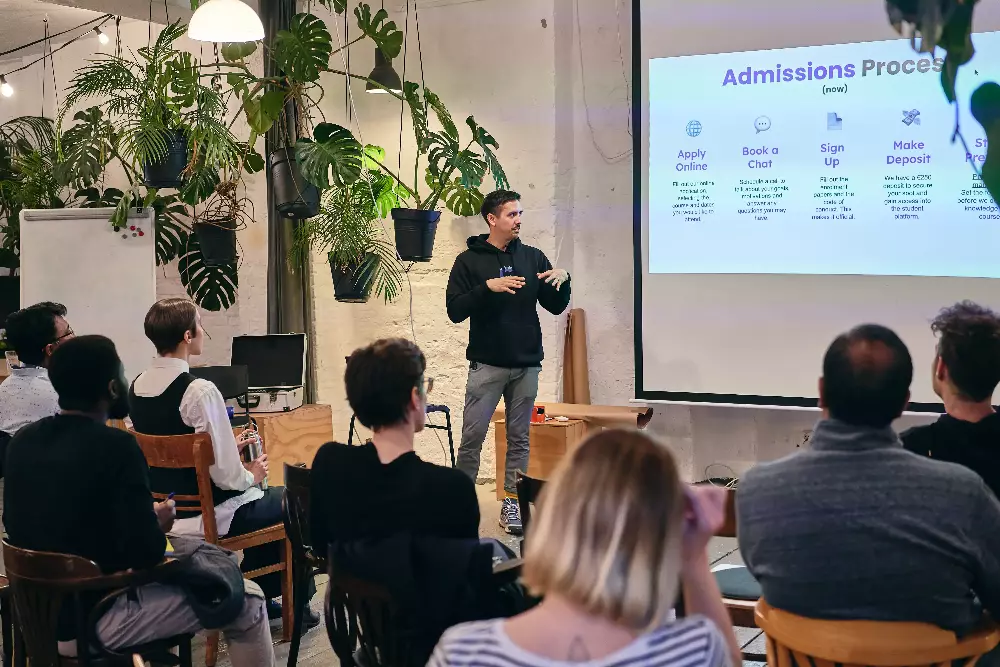
Learn technical skills online with Code Labs Academy
Join our supportive community, unlock your potential, and embark on a rewarding career path.
Apply Now