
Zero‑Trust Architecture for Clinical ML APIs with OAuth2, mTLS, and Audit Logging
Updated on January 19, 2026 19 minutes read
Clinical machine learning is increasingly delivered as an API. A discharge workflow calls a readmission risk model, a triage tool calls a sepsis screen, or a research portal calls a phenotype classifier to find eligible patients.
That API boundary often sits very close to sensitive data and real decisions. Even when the model itself is “just a score,” the surrounding system can touch regulated health information and influence time‑critical care workflows.
Meanwhile, the “trusted hospital network” assumption has weakened. Systems are hybrid, vendor‑integrated, remotely accessed, and full of service‑to‑service traffic, which means attackers don’t need to breach a single perimeter to cause harm.
This is where Zero‑Trust Architecture (ZTA) becomes practical. In zero trust, you don’t treat internal traffic as inherently safe; you verify identity and policy for each request, and you build traceability so you can understand what happened later.
This article is for ML engineers and backend engineers building clinical ML endpoints who want production‑grade security and observability. You’ll learn to validate OAuth2/OIDC tokens, add mTLS for workload identity, and implement audit logs that help investigations without leaking patient details.
After reading, you should be able to design a request flow that ties a clinician’s identity to a prediction request, enforce patient‑level authorization (not just “API access”), and run a FastAPI inference service with strong controls that fit clinical compliance and safety expectations.
Background and prerequisites
What you should already know before implementing this
You should be comfortable with Python and basic ML workflows. You should know how train/test splits work, how to evaluate classification models, and how to read JSON‑shaped request bodies in a web service.
You don’t need to be a cryptographer, but you should be familiar with what TLS does and what a JWT looks like. If OAuth2 is new to you, focus on the operational pieces: tokens, claims, scopes, issuer, and audience.
Clinical domain context: what changes when the “data is health data.”
Clinical features are rarely “clean.” Missing labs often mean “not ordered,” diagnoses reflect coding practice, and outcomes reflect both biology and care processes.
Clinical workflows are also socio‑technical. A risk score is interpreted by clinicians under time pressure, often alongside incomplete context, and the score can trigger downstream action like follow‑up calls or additional tests.
That combination makes security and safety tightly coupled. If an attacker can request predictions for patients they should not access, that is a privacy breach. If the system fails silently and emits incorrect scores, that can mislead care decisions.
Tech concepts you’ll use, in plain language
Zero trust means you don’t grant trust based on network location. You decide whether to allow each request based on identity, policy, and context, and you keep evidence (audit events) of what was allowed.
OAuth2 is a framework for delegated authorization to HTTP services. It is how a client proves it has permission to call an API, often on behalf of a user.
OpenID Connect (OIDC) is an identity layer on top of OAuth2. It standardizes identity claims so your API can reliably reason about “who” is behind a request.
mTLS (mutual TLS) authenticates both sides of the connection. In practice, it is a strong way to prove that the calling service is the service you expect, not merely something that found network access.
Audit logging is distinct from normal debugging logs. Audit logs are designed to answer “who accessed what, when, and under what authority,” in a way that supports investigations and compliance.
Core theory and intuition: zero trust as “per-request clinical authorization.n”
Think in terms of an access decision, not “an endpoint.”
A clinical /predict call isn’t just a function call. It is a request to act on a resource under sensitive context.
A useful framing is: allow subject to perform action on resource under context . For clinical inference, that can mean “Clinician identity + app identity requests a score for Patient X using Model Y.”
When you design with that framing, you stop treating authorization as a single checkbox. Instead, you treat it as an explicit decision that can be validated, logged, and reviewed.
Threat model: what goes wrong in real clinical integrations
Most incidents are not exotic. They are missing checks and default behaviors that were fine in a demo and dangerous in production.
A common failure is broken object‑level authorization. If the request includes a patient_id and you do not verify that the caller is authorized for that patient, then a token that should be limited becomes a patient‑scraping tool.
Another failure is token replay. Bearer tokens are called “bearer” because possession is sufficient to use them. If tokens leak via logs, proxies, or compromised workloads, someone can try to use them elsewhere.
A third failure is observability leakage. If request bodies or identifiers end up in logs, traces, or metrics tags, your monitoring stack becomes a shadow PHI database.
Why scopes alone don’t solve patient‑level authorization
OAuth scopes are necessary, but they are often coarse. A scope like ml.predict says “this token can call the prediction API,” not “this token can call the prediction API for Patient 123.”
Healthcare systems typically need patient context binding. The clean pattern is to carry patient context as an explicit claim, or to validate patient access through a policy service (care-team membership, encounter assignment, break‑glass workflows).
When you do this, you can enforce that the patient in the request matches the patient authorized by the token, or you can enforce a relationship check with the EHR’s access rules.
mTLS: transport identity that complements OAuth identity
OAuth2 and OIDC give you an application‑layer story: who is the user, what is the client, what scopes were granted. mTLS gives you a transport‑layer story: Is the connecting workload the workload you expect?
If a bearer token leaks, mTLS can reduce the blast radius by requiring the caller to present a certificate signed by your internal CA. In stronger designs, tokens can be bound to certificates, so replay becomes harder.
Operationally, mTLS becomes especially valuable in service‑to‑service traffic. Clinical platforms often have integration services, feature services, model services, and audit sinks, and you want each hop to verify identity.
The ML math that matters for clinical safety and thresholds
Clinical models are often used as risk scores. When you output a probability, clinicians and downstream systems treat it as a meaningful estimate.
A common baseline for tabular clinical risk is logistic regression:
Training typically minimizes cross‑entropy:
If downstream logic uses thresholds, calibration matters. A simple way to measure probabilistic accuracy is the Brier score:
In a clinical workflow, a miscalibrated score can cause systematic over‑triage or under‑triage. That is not just a model quality issue; it is a patient safety and operational risk issue.
Hands‑on implementation: train a clinical risk model with calibration and traceability
A realistic clinical feature shape
To keep this concrete, we’ll model 30‑day readmission risk. The dataset is tabular with a mix of numeric utilization features and categorical groupings.
In real hospitals, many categorical groupings come from governance decisions: how you map ICD codes into stable diagnosis groups, how you bucket age, and how you represent chronic conditions. Those mapping choices affect the distribution shift across sites.
You should treat the “feature schema” as part of your system contract. If your model expects a feature and it disappears in ETL, your inference service should fail loudly rather than silently producing nonsense.
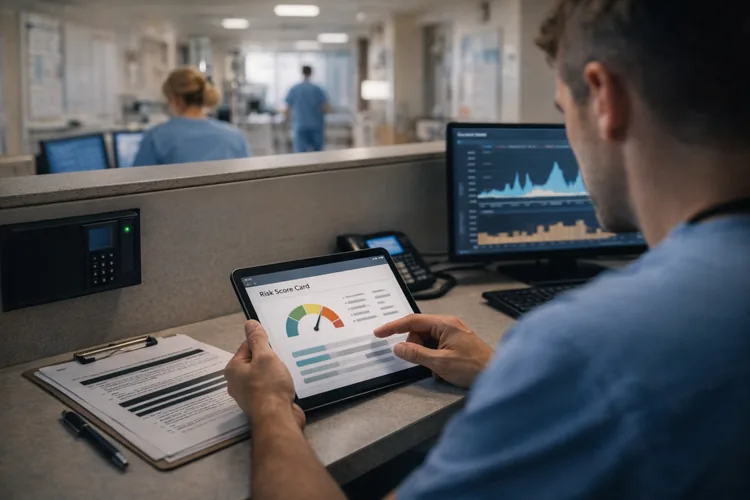
Training pipeline with preprocessing, imbalance handling, and calibration
The code below uses a scikit‑learn pipeline for preprocessing and a calibrated classifier for probability outputs. It also saves a model artifact plus metadata, so predictions can be traced to a specific version.
import json
from datetime import datetime, timezone
from pathlib import Path

import joblib
import pandas as pd

from sklearn.calibration import CalibratedClassifierCV
from skleare import ColumnTransformer
from sklearn.impute import SimpleImputer
from sklearn.linear_model import LogisticRegression
from sklearn.metrics import (
    roc_auc_score,
    average_precision_score,
    brier_score_loss,
    classification_report,
)
from sklearn.model_selection import train_test_split
from sklearn.pipeline import Pipeline
from sklearn.preprocessing import OneHotEncoder, StandardScaler

# Load a dataset shaped like a clinical feature extract.
df = pd.read_csv("readmission.csv")

label_col = "readmitted_30d"
y = df[label_col].astype(int)
X = df.drop(columns=[label_col])

numeric_features = [
    "time_in_hospital",
    "num_lab_procedures",
    "num_medications",
    "num_prior_inpatient_visits",
]

categorical_features = [
    "age_group",
    "sex",
    "primary_dx_group",
    "a1c_abnormal",
]

# Typical clinical preprocessing:
# - missing values are common and meaningful
# - categorical vocab can evolve over time
numeric_pipe = Pipeline(steps=[
    ("imputer", SimpleImputer(strategy="median")),
    ("scaler", StandardScaler()),
])

categorical_pipe = Pipeline(steps=[
    ("imputer", SimpleImputer(strategy="most_frequent")),
    ("onehot", OneHotEncoder(handle_unknown="ignore")),
])

preprocess = ColumnTransformer(
    transformers=[
        ("num", numeric_pipe, numeric_features),
        ("cat", categorical_pipe, categorical_features),
    ],
    remainder="drop",
)

# Balanced logistic regression is a strong baseline for clinical tabular problems.
base_model = LogisticRegression(
    max_iter=2000,
    class_weight="balanced",
    solver="lbfgs",
)

clf = Pipeline(steps=[
    ("preprocess", preprocess),
    ("model", base_model),
])

X_train, X_test, y_train, y_test = train_test_split(
    X, y,
    test_size=0.2,
    random_state=42,
    stratify=y,
)

clf.fit(X_train, y_train)

# Calibration is important when scores are interpreted as probabilities.
calibrated = CalibratedClassifierCV(
    estimator=clf,
    method="isotonic",   # use "sigmoid" if dataset is small
    cv=3,
)
calibrated.fit(X_train, y_train)

proba = calibrated.predict_proba(X_test)[:, 1]
pred = (proba >= 0.5).astype(int)

metrics = {
    "roc_auc": float(roc_auc_score(y_test, proba)),
    "avg_precision": float(average_precision_score(y_test, proba)),
    "brier": float(brier_score_loss(y_test, proba)),
}

print("Metrics:", json.dumps(metrics, indent=2))
print(classification_report(y_test, pred, digits=3))

# Save model artifact and metadata for traceability.
model_dir = Path("model_artifacts")
model_dir.mkdir(exist_ok=True)

artifact_path = model_dir / "readmission_risk_calibrated.joblib"
joblib.dump(calibrated, artifact_path)

metadata = {
    "model_name": "readmission-risk",
    "version": "2026-01-18",
    "trained_at_utc": datetime.now(timezone.utc).isoformat(),
    "features": {
        "numeric": numeric_features,
        "categorical": categorical_features,
    },
    "metrics": metrics,
    "notes": "LogisticRegression + isotonic calibration; class_weight=balanced.",
}

(model_dir / "metadata.json").write_text(json.dumps(metadata, indent=2))
print("Saved:", artifact_path)
Notice that we never assume the model is “good” just because AUC is decent. In clinical decision support, you care about ranking and calibration, and you care about how performance behaves across subgroups and settings.
Also notice that the metadata is not an afterthought. In a regulated environment, you want every prediction to be attributable to a specific model version and training configuration, because the clinical and legal questions eventually become “what did the system know at the time?”
A safer input contract: validate features and avoid PHI echoing
When you expose a endpoint, your request schema is a privacy boundary. It’s tempting to accept “anything,” but that can turn into accidental PHI ingestion, log leakage, and unbounded payloads.
A good first step is to only accept an explicit set of feature keys and types. The more your schema resembles your training pipeline, the less you risk silent failure modes caused by missing or renamed fields.
Wrapping the model in FastAPI with OAuth2/OIDC, mTLS, and audit logging
A zero‑trust request path you can implement
A realistic clinical call path often looks like this: a clinician uses an app embedded in a clinical workflow, that app obtains an OAuth2/OIDC token, and then it calls your ML API through a gateway.
The gateway is typically where TLS is terminated and where mTLS is enforced for workload identity. The ML API then verifies JWTs and enforces patient‑level authorization and logs audit events.
A key design decision is to separate normal application logs from audit logs. You can emit structured application logs for debugging, but audit logs should be restricted, append‑only, and designed for accountability.

JWT verification as an engineering task: issuer, audience, signature, expiry
A production ML API should validate that a token is intended for it and was issued by the right authority. That typically includes checking iss (issuer), aud (audience), exp (expiry), and verifying the signature using keys from a JWKS endpoint.
You also want to cache JWKS keys to avoid fetching on every request. Key rotation is normal, so your cache should refresh periodically and handle unknown kid values gracefully.
This is also where you enforce coarse authorization, such as requiring a scope like ml.predict. Scopes are not the full authorization story, but they are the first gate.
Patient‑level authorization: the “clinical zero trust” hook
After token validation, you must decide whether the caller can access the patient context requested. This is the most important difference between a generic ML API and a clinical ML API.
In some ecosystems, the token carries a patient context claim (for example, from a SMART launch context). In others, you call a policy service that checks care relationships or encounter assignment.
You should treat “break glass” as an explicit, logged workflow rather than a hidden bypass. If break glass is used, it should leave a clear audit trail and be rate‑limited and monitored.
FastAPI service: inference, auth, patient check, audit event
The code below loads the saved model and provides a /predict endpoint. It verifies a Bearer token, checks scope, provides a place to enforce patient‑level authorization, and writes an audit event.
It also avoids printing raw patient IDs or raw feature payloads. Instead, it hashes patient IDs for audit correlation and keeps audit logs minimal but useful.
import hashlib
import json
import os
import time
from datetime import datetime, timezone
from typing import Any, Dict, Optional

import httpx
import joblib
import jwt
from fastapi import Depends, FastAPI, HTTPException, Request
from pydantic import BaseModel, Field

# Environment-based config in real systems, backed by secrets managers.
OIDC_ISSUER = os.environ.get("OIDC_ISSUER", "https://idp.example.com/")
OIDC_AUDIENCE = os.environ.get("OIDC_AUDIENCE", "clinical-ml-api")
JWKS_URL = os.environ.get("JWKS_URL", "https://idp.example.com/.well-known/jwks.json")

MODEL_PATH = os.environ.get("MODEL_PATH", "model_artifacts/readmission_risk_calibrated.joblib")
MODEL_VERSION = os.environ.get("MODEL_VERSION", "2026-01-18")

app = FastAPI(title="Clinical ML API (Zero Trust)")

model = joblib.load(MODEL_PATH)

# JWKS caching to avoid network calls per request.
_JWKS_CACHE: Dict[str, Any] = {}
_JWKS_CACHE_TS: float = 0.0
_JWKS_TTL_SECONDS = 300


class PredictRequest(BaseModel):
    patient_id: str = Field(..., description="Prefer internal UUIDs to direct MRNs.")
    features: Dict[str, Any] = Field(..., description="Feature dict matching training schema.")


class PredictResponse(BaseModel):
    model_name: str
    model_version: str
    risk: float


async def _get_jwks() -> Dict[str, Any]:
    global _JWKS_CACHE, _JWKS_CACHE_TS
    now = time.time()

    if _JWKS_CACHE and (now - _JWKS_CACHE_TS) < _JWKS_TTL_SECONDS:
        return _JWKS_CACHE

    async with httpx.AsyncClient(timeout=5.0) as client:
        resp = await client.get(JWKS_URL)
        resp.raise_for_status()
        _JWKS_CACHE = resp.json()
        _JWKS_CACHE_TS = now
        return _JWKS_CACHE


def _extract_bearer_token(request: Request) -> str:
    auth = request.headers.get("authorization")
    if not auth or not auth.lower().startswith("bearer "):
        raise HTTPException(status_code=401, detail="Missing Bearer token")
    return auth.split(" ", 1)[1].strip()


def _has_scope(claims: Dict[str, Any], required: str) -> bool:
    # Common patterns: "scope" as a space-separated string, or "scp" as a list.
    scope_str = claims.get("scope", "")
    scopes = set(scope_str.split()) if isinstance(scope_str, str) else set()
    scp = claims.get("scp", [])
    if isinstance(scp, list):
        scopes |= set(scp)
    return required in scopes


async def require_auth(request: Request) -> Dict[str, Any]:
    token = _extract_bearer_token(request)
    jwks = await _get_jwks()

    try:
        header = jwt.get_unverified_header(token)
        kid = header.get("kid")
        if not kid:
            raise HTTPException(status_code=401, detail="Missing kid in token header")

        key = None
        for jwk in jwks.get("keys", []):
            if jwk.get("kid") == kid:
                key = jwt.algorithms.RSAAlgorithm.from_jwk(json.dumps(jwk))
                break
        if key is None:
            raise HTTPException(status_code=401, detail="Unknown signing key")

        claims = jwt.decode(
            token,
            key=key,
            algorithms=["RS256"],
            audience=OIDC_AUDIENCE,
            issuer=OIDC_ISSUER,
        )
    except jwt.ExpiredSignatureError:
        raise HTTPException(status_code=401, detail="Token expired")
    except jwt.PyJWTError:
        raise HTTPException(status_code=401, detail="Invalid token")

    if not _has_scope(claims, "ml.predict"):
        raise HTTPException(status_code=403, detail="Insufficient scope")

    return claims


def _hash_identifier(value: str) -> str:
    # In production, prefer HMAC with a rotated secret to reduce linkage risk.
    return hashlib.sha256(value.encode("utf-8")).hexdigest()


def _client_cert_fingerprint(request: Request) -> Optional[str]:
    # If mTLS terminates at a gateway/mesh, forward a fingerprint header.
    # Only trust this header if the gateway strips client-supplied values.
    return request.headers.get("x-client-cert-fingerprint")


async def authorize_patient_access(claims: Dict[str, Any], patient_id: str) -> None:
    # This is where clinical object-level authorization belongs.
    # Option 1: a token claim carries an allowed patient context.
    # Option 2: call a policy service that checks care relationships.
    allowed_patient = claims.get("patient_id")
    if allowed_patient is not None and allowed_patient != patient_id:
        raise HTTPException(status_code=403, detail="Token not valid for requested patient")


async def write_audit_event(event: Dict[str, Any]) -> None:
    # Replace with an append-only sink with strict access controls.
    # Do not store raw patient IDs or feature payloads in audit logs by default.
    print(json.dumps(event, separators=(",", ":")))


@app.post("/predict", response_model=PredictResponse)
async def predict(payload: PredictRequest, request: Request, claims: Dict[str, Any] = Depends(require_auth)):
    await authorize_patient_access(claims, payload.patient_id)

    # Model inference.
    try:
        import pandas as pd
        X = pd.DataFrame([payload.features])
        risk = float(model.predict_proba(X)[:, 1][0])
    except Exception:
        raise HTTPException(status_code=400, detail="Invalid feature payload")

    # Audit event.
    audit_event = {
        "ts_utc": datetime.now(timezone.utc).isoformat(),
        "event_type": "ml_prediction",
        "model_name": "readmission-risk",
        "model_version": MODEL_VERSION,
        "actor_sub": claims.get("sub"),
        "actor_username": claims.get("preferred_username") or claims.get("email"),
        "scopes": claims.get("scope", ""),
        "patient_id_hash": _hash_identifier(payload.patient_id),
        "mtls_client_fp": _client_cert_fingerprint(request),
        "request_id": request  .headers.get("x-request-id"),
        "decision": "allow",
    }
    await write_audit_event(audit_event)

    return PredictResponse(model_name="readmission-risk", model_version=MODEL_VERSION, risk=risk)
Local test call pattern, without leaking secrets
In many deployments, you will call this endpoint from an internal client, a gateway, or an app server. In local testing, it helps to keep the call shape explicit without hardcoding tokens into scripts.
A simple pattern is to set TOKEN in your shell and use curl with a JSON payload. In production, tokens should be short‑lived and never committed to repos.
export TOKEN="paste_access_token_here"

curl -sS http://localhost:8000/predict \
  -H "Authorization: Bearer $TOKEN" \
  -H "Content-Type: application/json" \
  -H "X-Request-Id: demo-req-001" \
  -d '{
    "patient_id": "patient-123",
    "features": {
      "time_in_hospital": 3,
      "num_lab_procedures": 25,
      "num_medications": 12,
      "num_prior_inpatient_visits": 1,
      "age_group": "[70-80)",
      "sex": "female",
      "primary_dx_group": "circulatory",
      "a1c_abnormal": "no"
    }
  }' | jq .
Deploying mTLS in front of FastAPI without making the app fragile
Where mTLS usually terminates
Most teams terminate TLS and enforce mTLS at a gateway or service mesh rather than inside the Python server. That choice simplifies certificate management and keeps the application code focused on auth, policy, and business logic.
When mTLS terminates upstream, the gateway can forward a client certificate fingerprint or workload identity as a header. Your application can then log that identity in audit events.
You must treat forwarded identity headers as trusted only if they come from the gateway. That means the gateway should strip inbound values and only inject its own.
A minimal gateway concept example
This example shows the concept of requiring a client certificate and forwarding its fingerprint. It is intentionally minimal and not a completely hardened configuration.
server {
  listen 443 ssl;

  ssl_certificate     /etc/tls/server.crt;
  ssl_certificate_key /etc/tls/server.key;

  ssl_client_certificate /etc/tls/ca.crt;
  ssl_verify_client on;

  location / {
    proxy_set_header X-Client-Cert-Fingerprint $ssl_client_fingerprint;
    proxy_set_header X-Request-Id $request_id;
    proxy_pass http://clinical-ml-api:8000;
  }
}
If you are using a mesh, you may prefer workload identities like SPIFFE IDs rather than raw certificate fingerprints. The conceptual goal is the same: bind service identity to transport.
Operations and MLOps: keeping clinical inference safe over time
Batch versus real‑time inference, and why it matters for reliability
Many readmission programs operate on batch lists: nightly stratification of discharged patients to prioritize outreach. That mode is stable and often easier to govern.
Point‑of‑care inference is different. Discharge workflows need quick, predictable latency, and failures need to be handled in a way that does not silently mislead clinicians.
A hybrid design often works well. You compute baseline risk in batch, then update it at key events (new lab result, discharge order placed), which reduces load and reduces the surface area of live data fetches.

Observability without turning monitoring into a PHI store
Clinical teams need to know if the model is slow, failing, or drifting. Engineers need to trace requests, measure latency, and monitor error rates.
You should keep patient identifiers and raw payloads out of general logs, traces, and metrics. Use a request ID for correlation and store patient‑linked evidence only in a restricted audit log sink.
If you later adopt OpenTelemetry, the practical win is centralized control over what attributes are attached to telemetry. That makes it easier to enforce “no PHI in telemetry” as an engineering policy.
Model monitoring: drift, calibration drift, and version governance
Even a “secure” endpoint can become unsafe if the model silently degrades. Changes in patient mix, coding, test ordering, or care pathways can shift feature distributions.
A useful operational habit is to track feature drift for key utilization variables and to track calibration drift over time. If the model’s predicted values stop matching observed frequencies, threshold policies become unreliable.
Always include model_version in responses and audit events. If you cannot answer “which model produced this score,” you cannot do meaningful governance or rollback.
Risk, ethics, safety, and governance for clinical ML APIs
Privacy and data minimization as default system behavior
Clinical ML systems should accept only the minimum features required for the prediction. The easiest way to violate privacy is to accept “any JSON” and accidentally ingest identifiers, notes, or free‑text content into logs and storage.
A safe contract is explicit schemas and explicit rejection of unknown keys. This also improves reliability, because unexpected fields can indicate upstream ETL or mapping changes.
Where possible, use pseudonymous identifiers in system logs. Audit logs can include hashed identifiers for correlation, but you should treat any linkage key as sensitive and rotate it with governance.

Bias and representativeness: technical metrics are not enough
Clinical datasets reflect care pathways and social context. A readmission model can learn patterns about access to follow‑up care as much as it learns medical risk.
Because the endpoint is easy to reuse, your biggest risk is “model used outside intended population.” An API makes it trivial to apply the model to a new hospital, unit, or patient group without validation.
You should document the intended use in the API and in the model card. You should monitor for shifts in input distributions that correlate with population changes.
Robustness and failure modes in clinical environments
A system can fail securely but still fail unsafely. If your endpoint returns a default score when it cannot validate inputs, clinicians may trust that score.
Failing safely usually means returning an explicit error and providing a clear operational path. If the model is unavailable, return a 503 and alert. If the token is invalid, return 401 or 403 and audit the denial.
For high‑impact thresholds, consider requiring a human review step. A score can be a triage signal, but it should not become an automatic decision without governance.
End‑to‑end scenario: discharge readmission risk in a clinical app ecosystem
A hospital deploys a discharge widget that shows readmission risk and recommended follow‑ups. The widget is embedded into the clinical workflow, so clinicians do not retype data into separate systems.
The app obtains authorization using OAuth2/OIDC and calls the ML API with a token that represents the clinician’s delegated access. The token includes a scope like ml.predict, and the system also carries patient context.
The request passes through a gateway that enforces mTLS. That means the calling workload must present a valid certificate, and the gateway forwards a workload identity signal to the ML API.
The ML API verifies the JWT, checks scopes, and then enforces patient‑level authorization. If the request asks for a patient outside the token’s authorized context, it denies the call.
When the prediction succeeds, the API returns a score and a model version. It also writes an audit event that includes the clinician identity, the hashed patient identifier, the model version, and the mTLS client fingerprint.
That design supports clinical work because it keeps the workflow fast while providing accountability. It also supports security operations because it produces clear evidence of access, even when the network cannot be trusted.
Skills mapping and learning path
From a bootcamp or career‑switcher perspective, the value of this project is that it spans ML, backend, and security. It mirrors the cross‑functional work you’ll see on real product teams that ship models into regulated environments.
On the ML side, you practice feature pipelines, imbalance handling, and calibration. You also learn why probabilistic accuracy matters when a “risk score” becomes a thresholded workflow decision.
On the backend side, you build habits that make services dependable: request validation, artifact loading, and predictable inference. You learn to be strict about schemas and intentional about error handling so failures are obvious and safe.
On the security side, you implement token verification as an engineering task, not a buzzword. You learn how to combine application‑layer identity (OAuth2/OIDC) with transport identity (mTLS), then record sensitive actions without leaking sensitive data.
A strong next step is to add a policy engine that evaluates patient access rules and purpose‑of‑use claims. Another strong step is to integrate a real identity provider and implement OIDC discovery and JWKS rotation robustly.
If you want a structured path to build these skills end‑to‑end, explore our training programs → Code Labs Academy Courses
Conclusion
Zero trust for clinical ML APIs means per‑request identity verification, explicit patient‑level authorization, and strong evidence trails. It is not just “use HTTPS” or “add JWT middleware.”
OAuth2/OIDC provides the identity and delegation layer that lets you tie prediction requests to accountable users and clients. mTLS adds workload identity and reduces risk from token replay in service‑to‑service environments.
Audit logging is a core requirement in clinical contexts, and it should be designed as a privacy‑aware product feature rather than an afterthought. If you can’t reconstruct “who requested what, when, and with which model,” you will struggle to govern the system.
If you build one thing from this article, build the smallest end‑to‑end stack that includes calibrated modeling, strict API schemas, token verification, patient‑level authorization hooks, and privacy‑aware audit events. That is already a serious, career‑relevant system.