
Supervised vs Unsupervised Learning Explained (2026)
Updated on January 22, 2026 5 minutes read
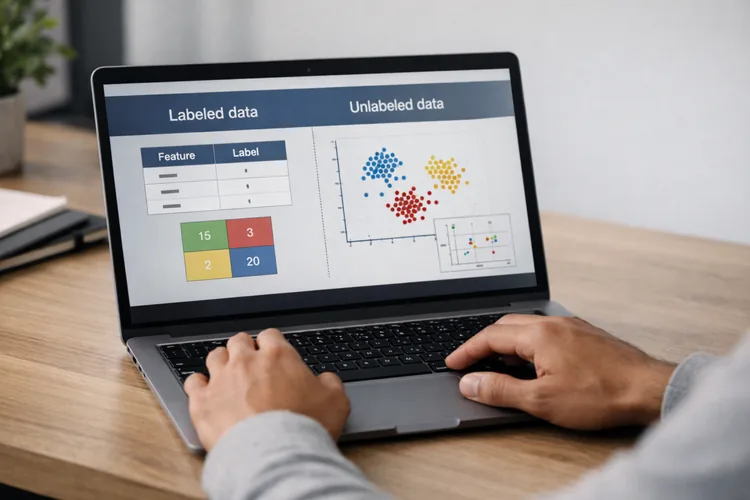
Supervised learning trains on labeled examples (inputs paired with correct outputs) to predict a specific target. Unsupervised learning trains on unlabeled data to discover structure, such as groups, similarities, or anomalies.
Clustering is usually an unsupervised method because it groups data without predefined labels. In real projects, clusters are often validated with domain knowledge or used as features in a later supervised model.
Start with supervised learning if labels are reliable, but consider semi-supervised approaches, active learning, or representation learning on unlabeled data to get more value from limited labels. The best choice depends on label quality and how expensive labeling is.